
 Deal
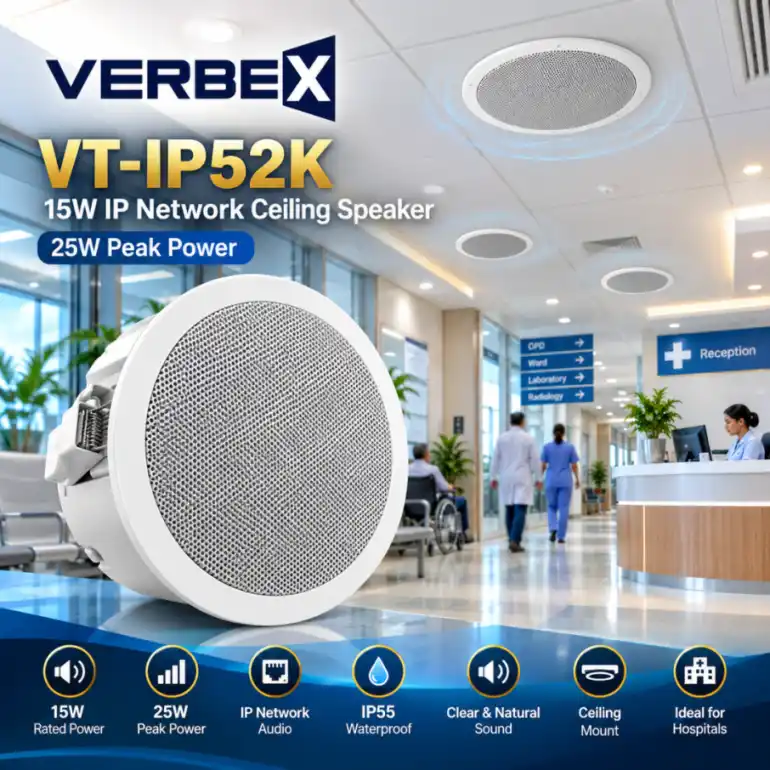
- 15W Rated Power & 25W Peak Power
- 5.25-Inch High-Quality Speaker Driver
- RJ45 Ethernet Network Interface (10/100Mbps)
Request a quote
Ceiling Speaker price in Bangladesh starts from ৳3,000 to ৳9,500; depending on brand, capacity and features. Buy best quality Ceiling Speaker from renowned brands at the Verbex Bangladesh online shop, and browse below to place an online order.
Explore Verbex Ceiling Speakers for public address announcements, background music, and distributed audio in offices, shopping malls, hotels, hospitals, schools, and commercial buildings. Discover professional ceiling-mounted speaker solutions designed for discreet installation, organized sound coverage, and integration with compatible PA amplifiers.
Showing 1 to 5 of 5 products
Deal
Request a quote
 Deal
৳6,500
 Deal
Request a quote
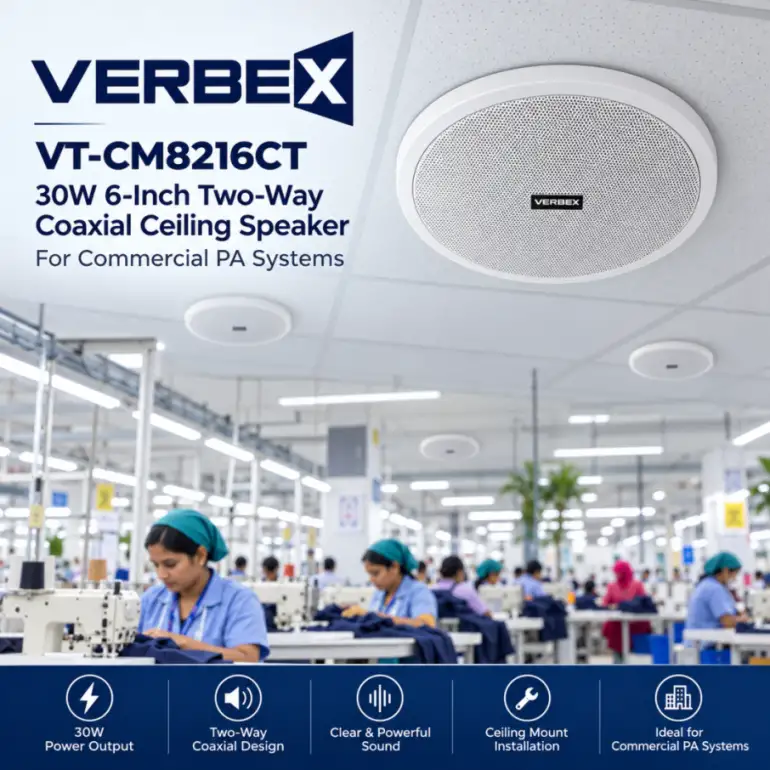
৳9,500
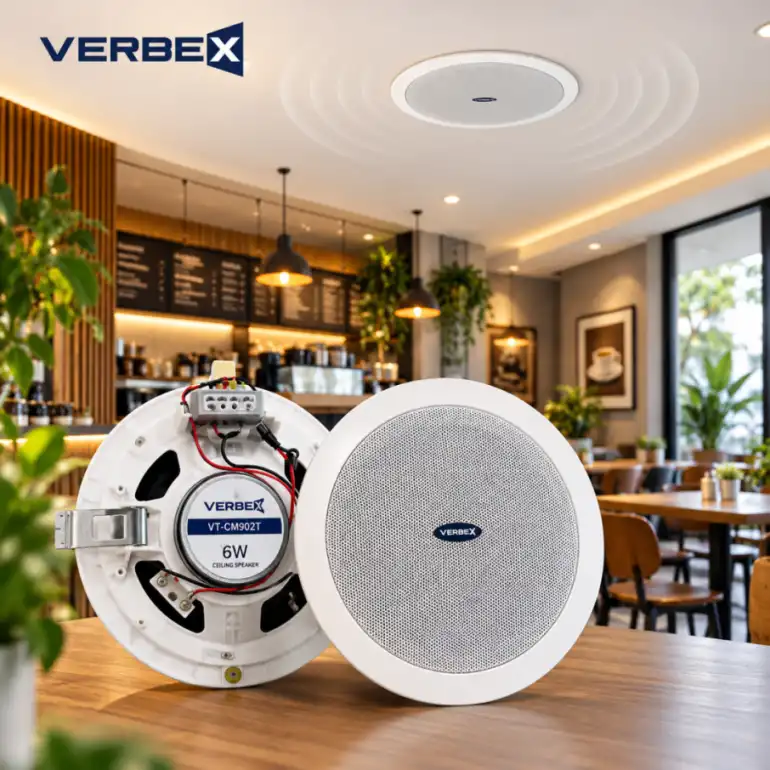
৳3,000
A well-designed audio system can make communication easier and improve the listening experience inside commercial and institutional buildings. Offices, shopping malls, hotels, restaurants, hospitals, schools, and other facilities often require clear announcements and comfortable background music across multiple areas.
One practical approach to distributed audio is the use of ceiling-mounted loudspeakers.
Verbex Ceiling Speaker is a professional audio equipment category for customers exploring ceiling speaker solutions for public address systems, voice announcements, background music, and commercial sound installations.
Ceiling speakers are commonly installed overhead, allowing audio equipment to occupy less visible wall or floor space. Their discreet appearance makes them relevant for interiors where maintaining a clean architectural design is important.
However, successful installation depends on more than the appearance of the speaker. Sound coverage, amplifier compatibility, mounting conditions, speaker spacing, and the acoustic environment must all be considered.
The exact performance and technical features of Verbex Ceiling Speaker models should always be confirmed from their individual specifications.
A ceiling speaker is a loudspeaker designed to be installed in or on a ceiling.
Many commercial ceiling speakers feature a circular grille that sits relatively close to the ceiling surface. Other models may use square grilles or surface-mounted enclosures.
Some ceiling speakers are recessed into a ceiling opening, while others are designed for direct surface installation.
The appropriate mounting method depends on the speaker model and the construction of the ceiling.
Ceiling speakers can be used for voice announcements, background music, and general audio distribution when their specifications suit the intended application.
They are frequently selected for locations where traditional floor-standing speakers would be impractical or visually distracting.
Commercial facilities often need sound across large floor areas without placing bulky speakers throughout the building.
Ceiling-mounted systems can provide an organized way to distribute audio while preserving usable space.
In offices, ceiling speakers may support announcements and low-level background audio.
In retail stores, they may help distribute music across customer areas.
In hotels, they may be considered for corridors, reception areas, lounges, and other selected spaces.
In each case, the number and positioning of speakers should be determined according to the dimensions of the area and the desired listening level.
A properly planned distributed system aims to avoid excessively loud spots near individual speakers and areas where sound is difficult to hear.
Public address systems are used to communicate information to people in a particular building or area.
Clear speech is especially important when announcements contain instructions, schedules, or other operational information.
Ceiling speakers can be useful in locations where listeners are spread across rooms, corridors, or open commercial spaces.
The intelligibility of announcements depends on the speaker's performance, mounting height, spacing, amplifier configuration, background noise, and room acoustics.
A speaker that produces sufficient volume may still deliver unclear speech if the installation is poorly designed.
For critical announcements, the system must be evaluated against the relevant safety and operational requirements.
Ordinary commercial ceiling speakers should not automatically be treated as certified emergency voice evacuation equipment.
Background music is widely used in shopping facilities, restaurants, cafés, hotels, and waiting areas.
A ceiling speaker installation may provide a visually discreet way to distribute music throughout these spaces.
For comfortable listening, the system should be designed around appropriate sound levels and reasonably consistent coverage.
The audio quality required for background music may differ from that needed for speech-only announcements.
For example, a restaurant may prefer a balanced musical presentation at moderate volume, while an office corridor may require primarily intelligible announcements.
Frequency response, speaker size, power handling, and amplifier compatibility should be considered when choosing a model.
Not all ceiling speakers provide the same musical performance.
Modern office buildings may require announcements, background audio, and communication across different departments.
Ceiling speakers can be installed in suitable reception areas, meeting rooms, corridors, and shared spaces.
Their overhead placement can help maintain a clean interior design without occupying desk or floor space.
In offices with several departments or floors, separate audio zones may be useful.
For example, management may need to broadcast an announcement to one area without affecting another.
This type of operation requires a compatible amplifier, zone selector, controller, or other appropriate system components.
The availability of zone management depends on the complete audio system, not merely on the ceiling speaker itself.
Shopping malls and retail stores often use distributed sound systems for music and announcements.
Ceiling speakers may be considered for customer areas, corridors, reception points, and selected common spaces.
The design should account for ceiling height, customer movement, surrounding noise, and the layout of shelves or partitions.
A large open retail floor may need a different speaker arrangement from a narrow corridor or small showroom.
Appropriate speaker spacing can help provide more balanced coverage.
For shopping facilities with multiple stores or sections, audio zoning may also be necessary to support independent operation.
Hotels and hospitality businesses often place importance on both sound quality and interior appearance.
Ceiling speakers may be used in reception areas, lounges, restaurants, corridors, and selected meeting spaces.
A discreet installation can help preserve the visual design of the interior.
However, the intended audio content should guide the choice of speaker.
A quiet hotel corridor may require low-level background music and announcements, while a busy restaurant may need a different audio configuration.
Where several areas operate independently, separate volume control or zoning may be appropriate.
The installation should also consider maintenance access and the condition of the ceiling structure.
Hospitals, clinics, and healthcare facilities may require distributed audio for general announcements and communication.
Ceiling speakers can be evaluated for suitable non-critical audio applications in corridors, waiting areas, reception spaces, and administrative zones.
Audio levels should be appropriate for patient comfort and the operational needs of the facility.
Any use involving emergency communication, life-safety announcements, or regulated healthcare infrastructure requires compliance with applicable standards and a properly specified system.
A general-purpose ceiling speaker should not be assumed to satisfy those requirements without verified certification and system-level assessment.
Educational institutions frequently use PA systems for announcements, administrative communication, and selected events.
Ceiling speakers may be suitable for classrooms, corridors, libraries, administrative offices, and other designated areas.
The correct arrangement depends on the ceiling height, room dimensions, background noise, and expected use.
For example, a classroom may need a different sound level from a busy corridor.
The number of speakers and the amplifier capacity should be calculated for the complete installation.
Educational institutions should also consider ease of operation and appropriate access controls for staff using the PA system.
Many commercial distributed audio installations use constant-voltage speaker systems, commonly described as 70V or 100V systems.
In such systems, compatible speakers can be connected to an appropriately designed amplifier distribution line.
Some ceiling speakers include transformers with selectable power taps.
These settings can allow installers to allocate suitable power to individual speakers within the system.
However, not every ceiling speaker supports 70V or 100V operation.
Some models are intended for low-impedance connections instead.
Before installation, verify the actual speaker configuration, transformer options, rated power, impedance, and amplifier output requirements.
For constant-voltage systems, the combined speaker tap settings must remain within the amplifier's permitted load.
Correct speaker placement is essential for balanced sound distribution.
The required spacing between ceiling speakers depends on the model's coverage characteristics, ceiling height, listening height, and room acoustics.
Speakers positioned too far apart may create areas with inadequate sound.
Placing too many speakers without proper planning can increase costs without necessarily improving clarity.
A qualified installer should review the floor plan and determine suitable speaker locations.
Special attention may be needed around partitions, high ceilings, reflective surfaces, and areas with significant ambient noise.
Ceiling speakers are available in different installation styles.
Recessed models are installed into prepared openings and often have a relatively low-profile appearance.
Surface-mounted models attach directly to the ceiling surface and may be more suitable for some building structures.
The choice depends on the ceiling material, available cavity depth, mounting requirements, and accessibility.
Before cutting or modifying a ceiling, installers should confirm structural suitability and check for electrical wiring, plumbing, and other hidden services.
Fire-rated ceiling assemblies may require specially approved speaker enclosures or installation methods.
Any applicable building and fire-safety requirements must be followed.
Ceiling speakers are usually one part of a larger audio system.
Other components may include mixer amplifiers, microphones, zone selectors, media players, and audio controllers.
The amplifier must be compatible with the speaker's electrical requirements.
For multi-speaker installations, cable routing and total system loading should be planned carefully.
Where independent volume control is required in different areas, suitable zoning equipment may be necessary.
The exact system architecture should be determined by the intended use and the verified specifications of the connected devices.
When comparing Verbex Ceiling Speaker models, begin with the intended installation environment.
Identify whether the main purpose is voice announcements, background music, or both.
Review the size of the area, ceiling height, desired listening level, and number of listeners.
Next, compare verified specifications such as rated power, frequency response, impedance, transformer options, physical dimensions, mounting depth, and environmental suitability.
Also check the availability of mounting accessories, warranty terms, and technical support.
For large commercial installations, a professional audio system design can help determine the correct speaker quantity and amplifier configuration.
Ceiling-mounted speakers should be inspected periodically according to the manufacturer's recommendations.
Grilles may collect dust over time, and mounting components should remain secure.
Cables and connections should be protected from damage and inappropriate environmental exposure.
Any cleaning or inspection that requires access above a ceiling should be performed safely by qualified personnel.
Correct installation and regular maintenance can help preserve reliable audio performance.
Verbex Ceiling Speakers are a relevant category for businesses and institutions seeking discreet audio distribution solutions.
They may be considered for offices, retail facilities, hotels, restaurants, schools, hospitals, and other suitable commercial environments.
The best speaker depends on the intended use, verified product specifications, ceiling conditions, and overall audio system design.
Explore available Verbex Ceiling Speaker models, compare their technical details, and select a suitable solution for your public address or background music installation.