
 Deal
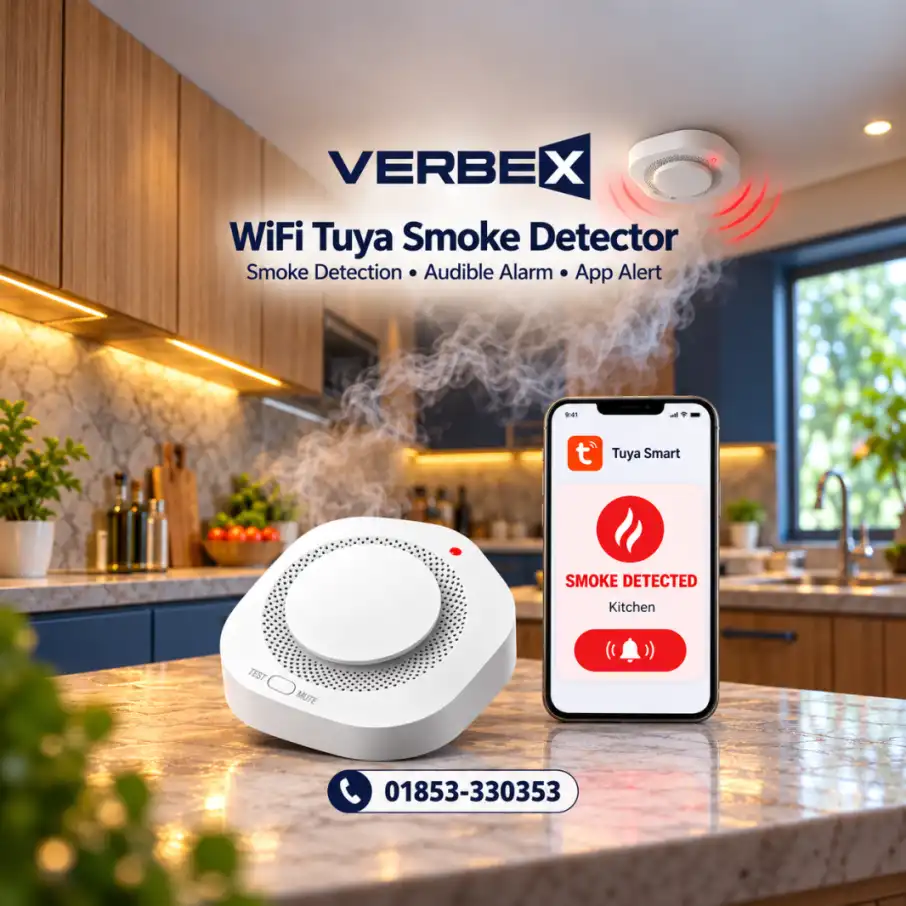
- WiFi Smart Smoke Detector
- Tuya Smart App
- Audible Alarm
৳2,750
Smoke Detector price in Bangladesh starts from ৳2,750 to ৳3,500; depending on brand, capacity and features. Buy best quality Smoke Detector from renowned brands at the Verbex Bangladesh online shop, and browse below to place an online order.
Explore Verbex Smoke Detectors for residential buildings, offices, hotels, hospitals, warehouses, commercial properties, and compatible fire alarm installations. Smoke detection devices are designed to identify smoke-related conditions and provide appropriate signals to fire alarm control equipment or integrated warning systems, depending on the model. Compare available photoelectric smoke detectors, conventional and addressable options, power requirements, mounting methods, environmental suitability, and verified fire alarm panel compatibility to select an appropriate solution for your building.
Showing 1 to 3 of 3 products
Deal
৳2,750
৳3,000
৳3,500
Fire safety is an essential consideration in residential, commercial, industrial, and institutional buildings. Smoke produced during a fire can create dangerous conditions, reduce visibility, and threaten occupants before flames reach every area of a building.
Appropriate smoke detection equipment can form part of an early-warning fire protection strategy.
Verbex Smoke Detector is a professional product category for customers exploring electronic smoke detection devices, conventional and addressable fire alarm detectors, compatible monitoring equipment, and fire safety system components.
Actual features, certifications, operating requirements, and compatibility must be verified for each product.
A smoke detector is a device designed to detect smoke-related conditions within a monitored area.
Depending on the product, it may send a signal to a fire alarm control panel or form part of a self-contained smoke alarm.
A smoke detector should not automatically be assumed to include its own audible alarm.
Smoke detection devices use different sensing technologies.
A photoelectric detector uses an optical sensing chamber to identify changes associated with smoke particles.
An ionization detector uses a different physical principle involving an ionization chamber.
The detection response depends on the technology, smoke characteristics, environmental conditions, and product design.
The terms are sometimes used interchangeably, but they can describe different equipment.
A smoke detector commonly operates as part of a fire alarm system.
A smoke alarm generally combines smoke sensing with an audible warning function in one unit.
The distinction is important when selecting equipment for a building.
Smoke detection products may include photoelectric detectors, ionization detectors, conventional detectors, addressable detectors, and specialized devices.
These classifications describe different aspects of sensing or system architecture.
For example, a photoelectric detector may also be conventional or addressable.
Photoelectric smoke detectors use optical sensing to detect smoke-related changes within a chamber.
They are widely used in fire detection applications.
Detection performance depends on smoke characteristics and the detector's design.
Ionization smoke detectors use a sensing chamber containing a small radioactive source.
They may respond differently to certain fire conditions compared with photoelectric devices.
Their sale, use, disposal, and regulatory treatment vary by jurisdiction.
Only verified, legally compliant products should be selected.
A conventional smoke detector typically connects to a compatible fire alarm control panel through a monitored detection circuit or zone.
The panel can indicate an alarm associated with that zone.
The exact detector location may not be individually identified.
An addressable smoke detector operates within a compatible addressable fire alarm system.
Depending on the system design, individual devices can be identified and monitored.
Addressable detectors must match the supported panel protocol and installation requirements.
A standalone smoke alarm generally provides a local audible warning when it detects qualifying smoke conditions.
Some models may be battery-powered or connected to building power.
Battery backup and interconnection capabilities vary by product.
Wired smoke detectors connect to compatible equipment using physical cabling.
They may be used in permanent fire alarm installations.
Wiring, circuit supervision, power, and panel compatibility must follow the approved system design.
Some fire detection equipment supports wireless communication.
Wireless systems may be useful in certain retrofit installations.
However, radio coverage, battery supervision, communication reliability, and regulatory compliance must be verified.
Residential properties require suitable smoke alarms or detection arrangements according to applicable safety requirements.
The correct number and placement depend on the building and local codes.
Household smoke alarms should not be replaced by a detector that lacks a suitable warning function.
Apartment buildings may require smoke detection in individual dwelling units and shared areas.
Requirements vary by building design and jurisdiction.
A qualified fire safety professional should determine the appropriate arrangement.
Offices may use smoke detectors as part of a coordinated fire alarm system.
The design should consider occupancy, room layout, air movement, and evacuation procedures.
Hotels contain guest rooms, corridors, common areas, and service spaces with different fire safety needs.
Smoke detection equipment should be selected and installed according to applicable building and fire safety standards.
Hospitals and healthcare facilities have complex fire safety requirements.
Detector placement, alarm notification, compartmentation, and evacuation planning require professional coordination.
Medical facilities should use appropriately approved systems.
Warehouses may have high ceilings, shelving, dust, and variable airflow.
These conditions can influence detector suitability.
Large or complex warehouses may require specialized fire detection design.
Retail stores may use smoke detectors to support early fire detection.
The system should be coordinated with alarm notification and emergency procedures.
Schools, colleges, and other educational facilities may require smoke detection as part of their fire protection systems.
System design should consider occupancy and safe evacuation.
Smoke detectors can form part of a broader fire alarm installation.
Compatible control panels may process alarm and fault signals.
System design, installation, testing, and commissioning should follow applicable requirements.
A fire alarm control panel receives and processes signals from compatible detection devices.
Depending on the system, it may activate notification appliances or other approved fire safety functions.
Detector-to-panel compatibility must be verified.
A fire alarm system may include sounders, bells, strobes, or other notification equipment.
A smoke detector does not necessarily operate these devices directly.
Alarm notification must be designed for the building's requirements.
Detector placement affects performance.
Ceiling geometry, walls, airflow, ventilation, and environmental conditions must be considered.
Follow the applicable code, approved design, and manufacturer's installation instructions.
Many smoke detectors are designed for ceiling installation.
However, permitted mounting positions and spacing vary by product and applicable standards.
Incorrect placement may delay detection or cause unwanted alarms.
Cooking fumes and steam may trigger some smoke detection devices.
Kitchen and adjacent-area detector selection requires careful consideration.
Heat detection may be appropriate in some locations, but only where permitted by the applicable fire safety design.
Dust can interfere with certain smoke sensing technologies.
Industrial or dusty locations may require specialized detectors or alternative arrangements.
A qualified designer should evaluate the environment.
Smoke detector sensitivity is established by the device design and applicable performance requirements.
Some systems support authorized configuration or sensitivity management.
Adjustments should only be performed according to manufacturer instructions and relevant standards.
Cooking aerosols, steam, dust, contamination, and inappropriate placement may cause unwanted alarms.
Correct product selection and maintenance can help reduce nuisance alarms.
Fire detection devices should never be disabled simply to avoid alarms.
Smoke detectors may use power supplied by a fire alarm panel, building electrical circuits, or batteries.
The exact requirements depend on the model.
Approved power and backup arrangements are essential.
Some smoke alarms and detection systems include backup power provisions.
Backup capability should be verified from the product and system specifications.
Battery-powered devices require regular maintenance and timely replacement.
Some smoke alarms can be interconnected so that multiple compatible units provide coordinated warnings.
This capability is not universal.
Interconnection requirements and compatibility must be verified.
Smoke detection devices should be tested according to manufacturer instructions and applicable fire safety standards.
Aerosol testing, electronic test functions, and other procedures may be used where approved.
Improvised testing with open flames is unsafe.
Dust and contamination can affect smoke detection equipment.
Maintenance should follow the manufacturer's approved procedures.
Professional inspection and testing may be required for commercial systems.
Smoke detection devices have finite service lives.
Replacement intervals depend on the product, applicable standards, and manufacturer guidance.
Damaged, expired, or unreliable devices should be replaced appropriately.
Fire detection equipment may be evaluated under relevant standards and certification schemes.
Applicable requirements differ by market and application.
Certification claims should be supported by authentic documentation for the exact model.
Commercial fire alarm installations should be designed, installed, commissioned, and maintained by appropriately qualified personnel.
Building-specific code requirements and authority approvals may apply.
First identify the building type and whether the requirement is for a standalone smoke alarm or a detector connected to a fire alarm system.
Then verify sensing technology, system architecture, certification, power requirements, mounting conditions, and compatibility.
A qualified fire safety professional should confirm suitability for the intended installation.
Verbex Smoke Detector is a relevant category for customers exploring smoke detection equipment for residential, commercial, and institutional fire safety applications.
Properly selected and maintained detection equipment can support a building's fire warning strategy.
Explore available Verbex smoke detection products and compare their verified specifications, approvals, and system compatibility before selection.