
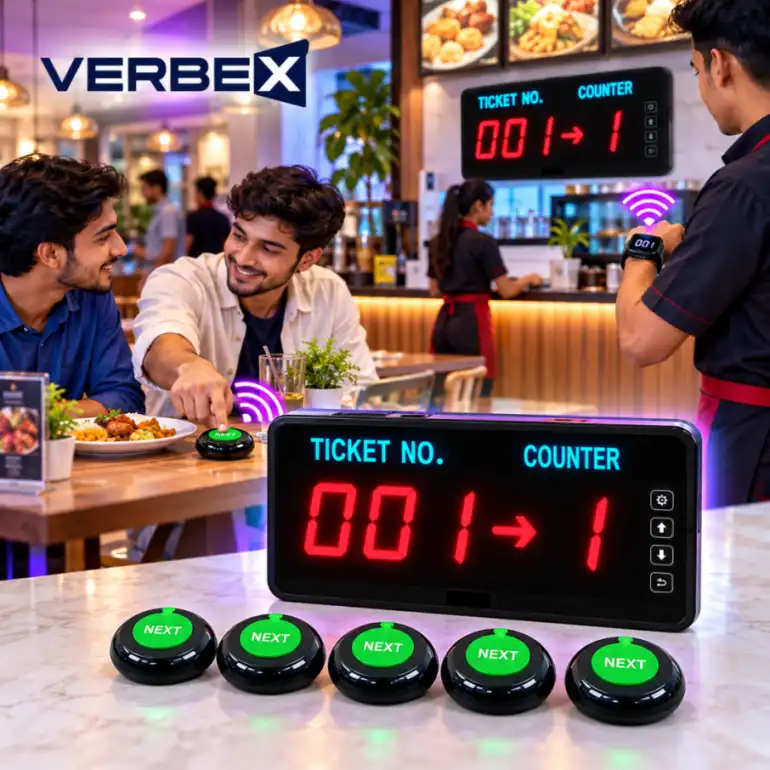
- Buzzer
- Perfect For Restaurant
- Restaurant
Request a quote
Looking for the latest Kitchen call waiter system price in Bangladesh? Prices depend on brand, capacity and features. Browse the range below and ask Verbex Bangladesh for a quotation on the products you need.
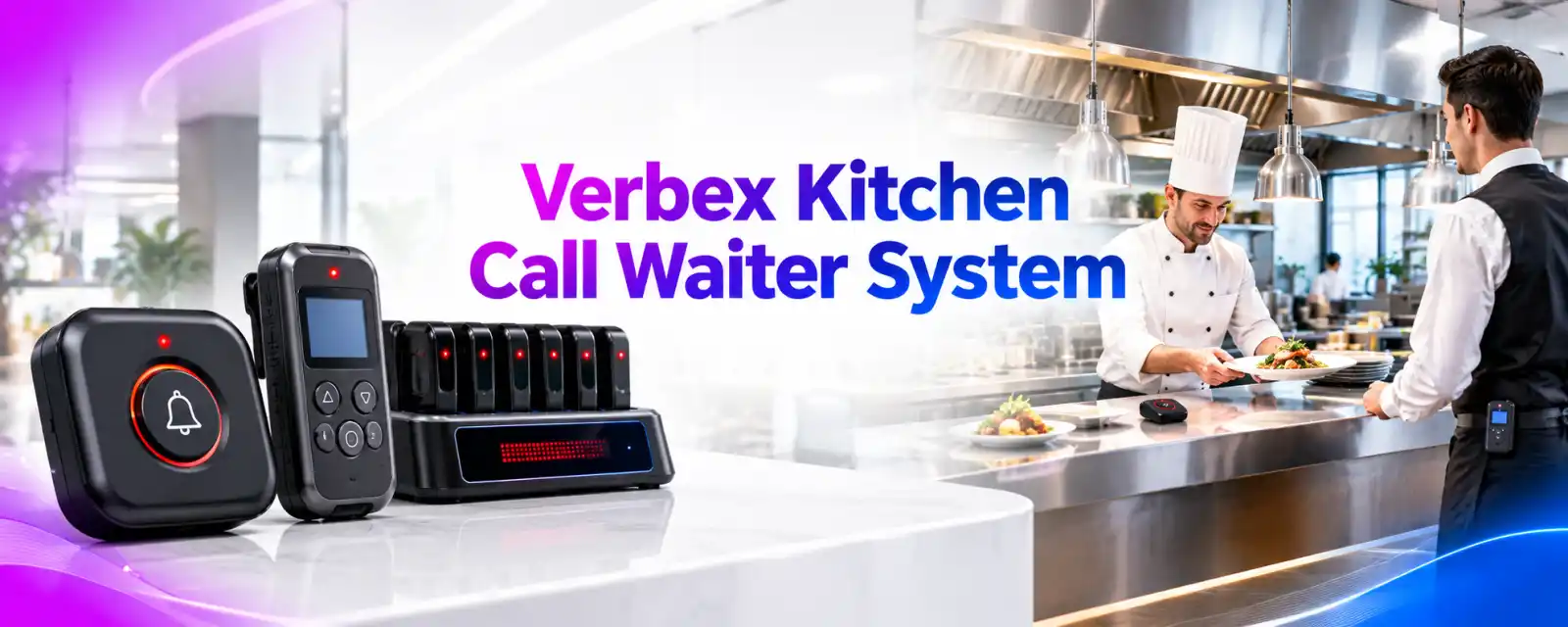
Explore Verbex Kitchen Call Waiter Systems for organized communication between restaurant kitchens and service staff. A compatible wireless kitchen calling solution can help chefs or kitchen personnel notify waiters when food is ready for collection, reducing reliance on verbal calls and repeated kitchen checks. Suitable for restaurants, cafés, hotel kitchens, food courts, and hospitality businesses, this equipment category covers kitchen call transmitters, compatible waiter receivers, paging displays, and staff notification solutions where available. Compare verified device compatibility, wireless coverage, alert methods, receiver capacity, power requirements, and installation options to select an appropriate kitchen-to-waiter communication system.
Showing 1 to 5 of 5 products
Request a quote
Request a quote
Request a quote
Request a quote

Request a quote
Efficient communication between kitchen staff and restaurant waiters is an important part of food service operations. When chefs finish preparing an order, the service team needs to know that the meal is ready for collection and delivery to the correct table.
In a busy restaurant, kitchen employees may need to call waiters repeatedly, while servers may spend time checking whether orders have been completed. These interruptions can complicate communication, particularly during peak service hours.
A properly selected kitchen call waiter system provides a dedicated notification method between food preparation areas and service staff.
Verbex Kitchen Call Waiter System is a professional restaurant communication equipment category for kitchens, cafés, hotels, food courts, and other hospitality environments seeking wireless staff calling and food ready notification solutions.
Actual features depend on the selected transmitter, receiver, communication technology, and system configuration.
A kitchen call waiter system is an electronic notification solution used to contact service staff from a kitchen or food preparation area.
When an order is ready, an authorized kitchen employee activates a call transmitter.
A compatible receiver alerts the designated waiter or service team.
The notification may appear on a fixed display or portable device, depending on the system.
The equipment does not necessarily identify the order automatically or integrate with restaurant software.
A typical system includes a kitchen-side transmitter and one or more compatible receiving devices.
The chef or kitchen employee presses the designated call button when a meal is ready.
The transmitter sends a signal to the receiving equipment.
A waiter can then respond to the notification and collect the prepared order.
Some systems use receiver identifiers to direct calls to particular staff members.
The supported workflow must be verified for each product.
A kitchen-to-waiter communication setup may include a kitchen call button, wireless transmitter, portable waiter receiver, central receiver display, and suitable power accessories.
Different configurations support different operating requirements.
A small restaurant may need only a simple transmitter and receiver arrangement.
A larger establishment may require multiple calling points or receiver groups.
Compatibility and supported capacity should be confirmed before installation.
The kitchen call button is an important component of the system.
It allows kitchen staff to send a notification without leaving the food preparation or pickup area.
The button should be positioned where authorized employees can reach it conveniently.
Some transmitters provide a single calling function.
Others may support multiple call selections.
The available functions depend on the specific device.
A wireless transmitter sends a call signal from the kitchen to compatible receiving equipment.
Wireless technology may reduce the need for dedicated communication cables between the kitchen and service areas.
However, range and signal reliability depend on the device and building conditions.
Walls, metal surfaces, kitchen appliances, and electrical equipment may affect communication.
A site test is recommended for complex premises.
Some kitchen calling systems support portable receivers carried by waiters.
These devices may alert staff without requiring them to remain near a fixed display.
Depending on the model, alerts may be audible, visual, or vibration-based.
Battery capacity, receiver compatibility, and notification behavior should be checked.
Not all systems support portable paging.
A fixed receiver display can provide a central point for kitchen notifications.
It may be installed near a service station or food pickup area.
Some displays identify the calling transmitter or assigned staff group.
Display size, alert type, call history, and capacity vary between products.
Restaurants should select equipment that matches their staffing arrangement.
Food ready notification is one of the main applications of kitchen-to-waiter calling.
When the kitchen completes a meal, the service team receives a signal indicating that attention is required.
This can help reduce reliance on shouting or repeated kitchen visits.
However, a basic calling signal may not contain order details.
Staff must still confirm the correct food and destination table.
Clear communication between the kitchen and dining room helps staff coordinate service.
A calling system can provide a dedicated alert channel.
However, it should complement the restaurant's existing order management and staff procedures.
The system is most useful when employees understand who should respond to each notification.
Restaurants may operate with multiple waiters, food runners, and kitchen stations.
A calling system can help organize notifications between these groups.
The appropriate configuration depends on staff responsibilities and service layout.
Managers should define which employees receive calls and how they respond.
Electronic alerts alone do not replace operational planning.
Without a dedicated notification method, waiters may return to the kitchen frequently to check order status.
A kitchen calling system may reduce unnecessary checks when notifications are used consistently.
However, staff may still need to visit the kitchen for other operational reasons.
The benefit depends on the restaurant's workflow.
During lunch and dinner rushes, kitchen and service teams handle many orders simultaneously.
A reliable calling arrangement may help staff recognize when food requires collection.
Clear alert assignments can reduce confusion.
However, peak-hour performance should be tested with the expected number of active devices and staff members.
Full-service restaurants may use kitchen calling to coordinate food pickup and table delivery.
A central kitchen transmitter can be useful where prepared dishes are collected from a designated pass.
The receiver arrangement should reflect how waiters and food runners are assigned.
The goal is to support clear communication rather than create unnecessary alerts.
Cafés may prepare food and beverages at separate counters.
A calling system can help notify staff when a prepared item is ready.
However, the required equipment depends on whether the café uses table service, counter collection, or a combination of both.
Kitchen-to-staff paging and customer guest paging are different applications.
Hotels may operate restaurants, banquet kitchens, cafés, and other food service areas.
These facilities can have different communication needs.
A kitchen calling system may support coordination between a preparation area and designated service staff.
Larger hotel installations should consider the number of kitchens, service points, and staff groups.
Food courts may contain multiple food preparation counters and shared dining spaces.
A kitchen calling solution can be used to notify staff responsible for collecting completed orders.
However, each vendor may have different equipment requirements.
Wireless interference and compatibility should be evaluated where several systems operate nearby.
Quick-service restaurants often need to move prepared food efficiently from kitchen stations to pickup counters.
A staff calling system may support internal notifications.
It should not be confused with a guest paging system that directly alerts customers.
The appropriate equipment depends on whether the intended recipient is an employee or a customer.
The kitchen pass is where completed dishes are often checked and transferred to service staff.
Positioning a call transmitter near this area may make notifications convenient.
However, it should not obstruct food handling or cleaning.
The device location should be selected according to the kitchen layout and operating procedures.
Some paging platforms may allow calls to be directed to different staff receivers or groups.
This can be relevant where several waiters share responsibility for different dining sections.
However, multi-receiver addressing is not universal.
Restaurants must confirm the transmitter's supported call options and receiver capacity.
When multiple devices operate in one restaurant, clear receiver identification is important.
Some systems use assigned numbers or identifiers.
Accurate device mapping can help staff recognize the intended recipient.
Managers should maintain a record of transmitter and receiver assignments.
This is especially useful when staff roles or equipment locations change.
Different service environments may require different notification methods.
Audible alerts may be useful in some staff areas.
Visual alerts may be preferable where noise should be minimized.
Portable vibration alerts can be suitable when supported by the device.
The selected alert should be noticeable without becoming disruptive.
Wireless coverage is an important selection factor.
Published operating distances may reflect ideal test conditions.
Commercial kitchens contain metal equipment, appliances, and structural barriers that can influence signal performance.
Coverage should be tested between the kitchen and all intended receiving areas.
Wireless calling systems may operate on different radio frequencies.
The applicable frequency regulations vary by country.
Nearby wireless equipment may also create interference.
Restaurants should verify that the selected system is suitable for local operation.
Kitchen transmitters and waiter receivers may use replaceable batteries, rechargeable batteries, or external power supplies.
The arrangement depends on the product.
Battery life can vary with notification frequency and operating conditions.
Restaurants should plan charging and battery replacement procedures to avoid interruptions during service.
Kitchen environments require careful attention to hygiene.
A calling button may be exposed to grease, moisture, flour, or food residue.
Equipment should be installed away from direct heat and unsuitable exposure.
Cleaning must follow the manufacturer's instructions.
Water resistance should not be assumed without a verified rating.
Begin by identifying the kitchen calling point and the staff members who need notifications.
Select compatible transmitters and receivers.
Assign identifiers where supported.
Install or position the equipment according to manufacturer instructions.
Test calls from the kitchen to each intended receiver.
Kitchen employees should understand when to send a notification.
Waiters should know which alerts require their response.
If the system supports acknowledgement or call clearing, staff should learn those functions.
Managers should establish a procedure for handling missed or repeated calls.
Routine checks should include transmitter buttons, receiver operation, batteries, charging equipment, and cable connections where applicable.
If a notification is not received, inspect power, pairing, coverage, and compatibility.
Damaged equipment should be repaired or replaced appropriately.
Regular testing can help identify problems before busy service periods.
Some advanced restaurant platforms may connect notifications with kitchen display systems or point-of-sale software.
However, ordinary kitchen call transmitters do not automatically support such integration.
Any connection to POS, order management, or kitchen display software requires verified interfaces and compatibility.
Start by identifying the number of kitchen calling points and staff receivers required.
Consider the distance between the kitchen and dining areas.
Evaluate verified wireless coverage, receiver capacity, notification methods, power requirements, and installation conditions.
Determine whether individual staff calling or group notification is necessary.
For larger restaurants, test the system under realistic operating conditions.
Verbex Kitchen Call Waiter System is a relevant product category for restaurants and hospitality businesses looking to organize food ready notifications and kitchen-to-service communication.
A properly selected system can help kitchen staff contact designated waiters without relying entirely on verbal calls.
Explore available Verbex kitchen calling equipment, compare verified specifications, and select a solution that matches your restaurant's service workflow.
| Product | Price |
|---|---|
| Verbex VT-K-100 K-O1 1+5 Calling Bell With Buzzer Perfect For Restaurant | Price on request |
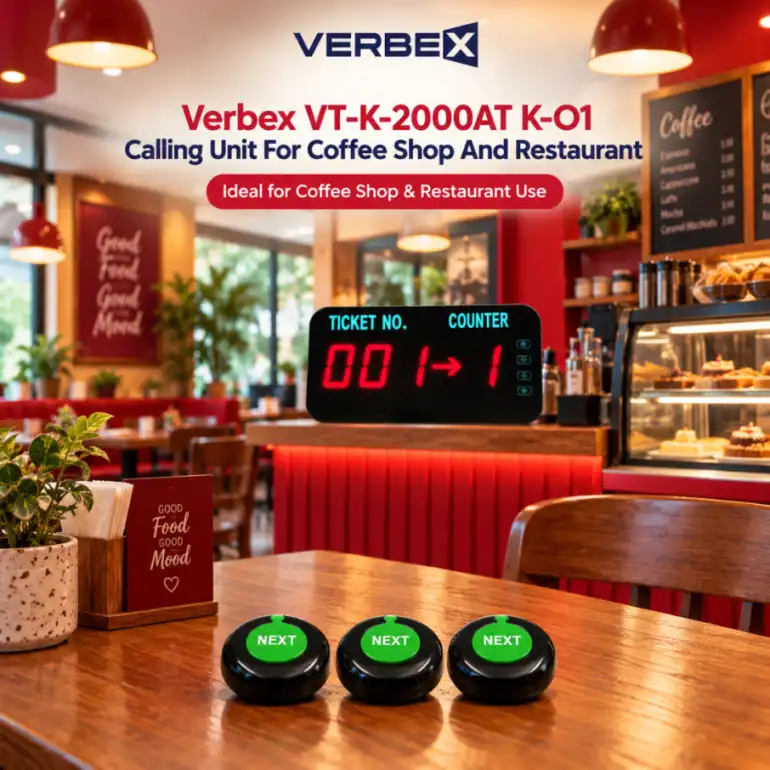
| Verbex VT-K-2000AT K-O1 Calling Unit For Coffee Shop And Restaurant | Price on request |
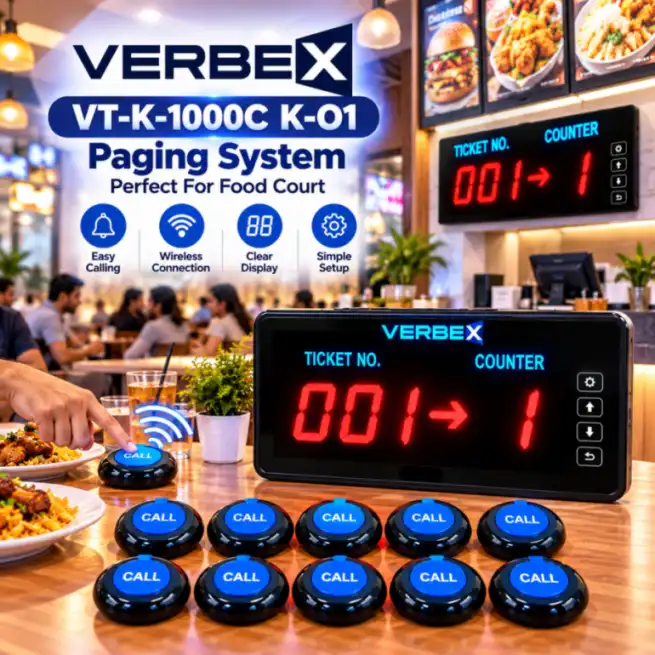
| Verbex VT-K-1000C K-O1 Paging System Perfect For Food Court | Price on request |
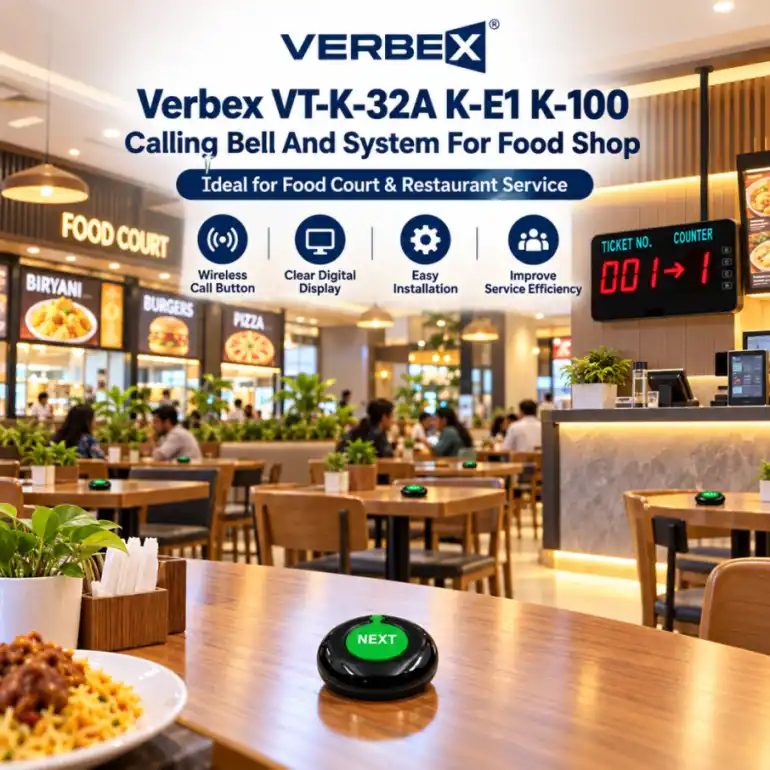
| Verbex VT-K-32A K-E1 K-100 Calling Bell And System For Food shop | Price on request |
| Verbex VT-K-TP20 Guest Coaster Pager Unit For Restaurant | Price on request |