
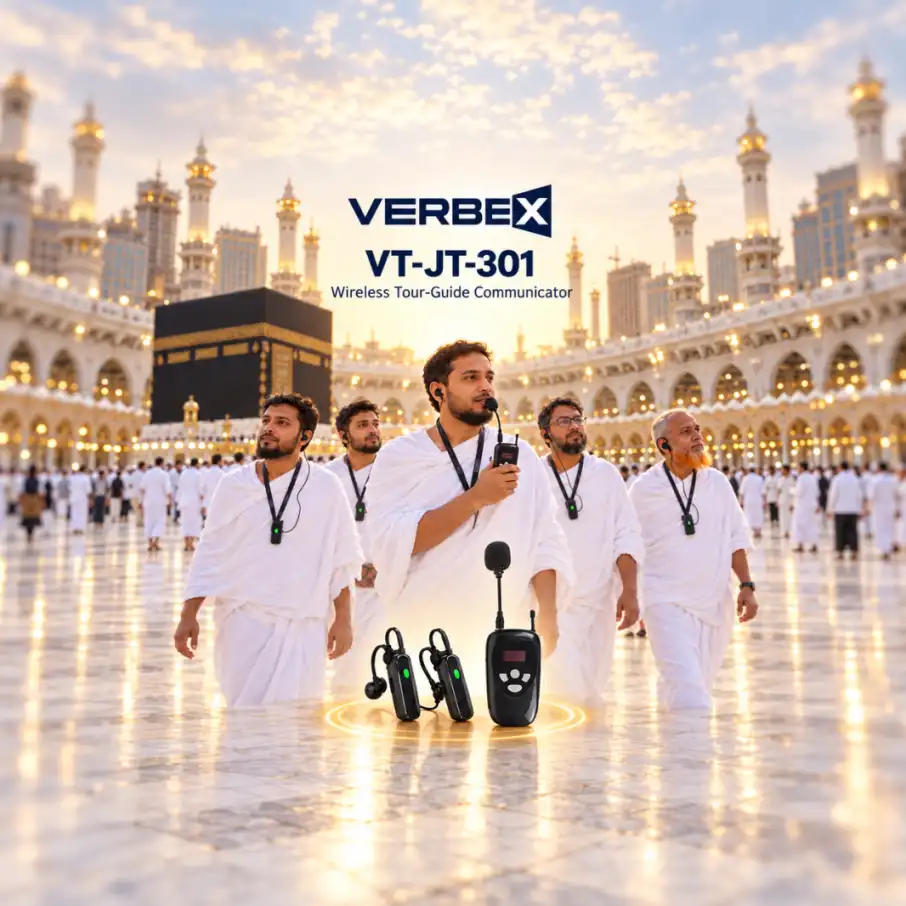
- Wireless
- Guide Communicator
- Tour-Guide Communicator
Request a quote
Looking for the latest Wireless Tour-guide System price in Bangladesh? Prices depend on brand, capacity and features. Browse the range below and ask Verbex Bangladesh for a quotation on the products you need.
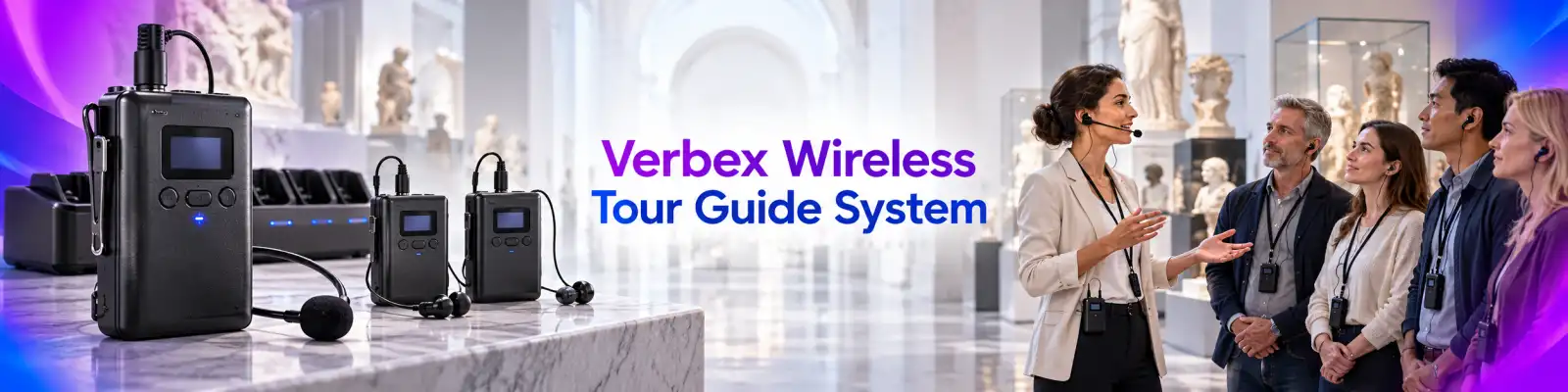
Verbex Wireless Tour Guide Systems for guided tours, museums, factories, exhibitions, educational visits, historical attractions, and organized group activities. A compatible wireless tour guide system allows a presenter or guide to speak through a microphone and transmit audio to participants using portable receivers and suitable earphones or headsets. Compare available Verbex tour guide transmitters, wireless receivers, microphones, earphones, charging stations, supported channels, battery requirements, communication coverage, and device compatibility to choose an appropriate group audio communication solution.
Showing 1 to 2 of 2 products
Request a quote

Request a quote
Clear communication is essential when a guide, instructor, or presenter needs to address a group while moving through different locations. In museums, factories, exhibitions, historical sites, and educational visits, background noise, physical distance, and room acoustics can make ordinary speech difficult to hear.
A wireless tour guide system can provide a practical communication method by transmitting the guide's voice directly to portable listening devices.
Verbex Wireless Tour Guide System is a professional audio communication equipment category for organizations exploring portable voice transmitters, group listening receivers, guide microphones, earphones, charging accessories, and related wireless tour communication solutions.
Actual functionality depends on the selected equipment and its verified specifications.
A wireless tour guide system is an audio transmission arrangement that allows a speaker to communicate with a group of listeners through compatible wireless receivers.
The guide typically uses a microphone connected to a portable transmitter.
Participants carry individual receivers and listen through suitable earphones or headsets.
The exact transmission technology depends on the system.
In a common configuration, the guide speaks into a microphone.
The transmitter sends the audio signal to receivers assigned to the same compatible channel or group.
Participants hear the transmitted speech through their listening devices.
Channel selection, pairing, and receiver capacity vary by model.
A tour guide setup may include a portable transmitter, microphone, multiple receivers, earphones, charging equipment, carrying accessories, and storage cases.
Some systems provide integrated components.
Others require separately compatible accessories.
Not every package includes all equipment.
The transmitter is used by the guide or presenter.
It may be designed for handheld, belt-mounted, or other portable operation.
The transmitter's controls, microphone connection, battery arrangement, and channel support depend on the selected model.
Each participant may receive a compact wireless receiver.
The receiver processes compatible audio signals and delivers them through connected listening equipment.
Size, volume adjustment, display functions, and battery requirements vary.
A suitable microphone allows the guide's voice to enter the transmission system.
Different models may support headset, lapel, or handheld microphone arrangements.
The correct microphone must match the transmitter's input requirements.
Participants commonly listen through earphones or headsets.
Comfort and hygiene are important, particularly during extended tours.
Earphone compatibility and connection type should be verified.
Organizations may need procedures for cleaning or replacing shared listening accessories.
Many tour guide applications involve one presenter speaking to several listeners.
This arrangement can help distribute the same explanation across a group.
However, the number of receivers supported by a particular system must be verified.
Wireless group listening allows participants to hear the guide without remaining directly beside the speaker.
This can be useful when a group is spread across a room or moving through a site.
The effective operating distance depends on equipment and environmental conditions.
Museums may use wireless tour guide equipment for guided exhibitions and educational programs.
A guide can explain artworks, collections, or historical objects to participating visitors.
The system should be selected according to group size, room layout, and visitor needs.
Historical attractions often involve outdoor areas or multiple buildings.
Portable audio communication may help guides provide explanations while participants move between locations.
Coverage and environmental suitability should be assessed before use.
Factories can contain machinery and background noise.
A suitable wireless listening system may help visitors hear a guide's explanations.
However, ordinary tour guide equipment is not automatically certified as hearing protection or industrial safety communication equipment.
Site safety requirements must take priority.
Industrial facilities may require communication across designated visitor routes.
Portable audio systems can support guided explanations.
However, hazardous environments may require specialized certified equipment.
Standard consumer or commercial transmitters should not be used in restricted areas without appropriate approval.
Exhibitions and trade shows can be crowded and noisy.
A wireless tour guide system may help presenters communicate with registered group participants.
Multiple nearby groups may require suitable channel planning.
Schools, colleges, and universities may use group listening equipment during educational visits.
Teachers or instructors can provide explanations while students move through a museum or other learning environment.
Device handling and supervision should be appropriate to the age of participants.
Universities and institutions may conduct campus tours for visitors and prospective students.
Portable guide systems can support spoken explanations during group movement.
The equipment should be selected according to tour route and participant numbers.
Walking tours often move through streets, parks, and public attractions.
Wireless receivers may allow participants to hear the guide without crowding closely around them.
Local regulations and environmental conditions should be considered.
Organized cultural or religious visits may involve guided explanations for groups.
A suitable wireless audio system can support clear speech delivery.
The equipment should respect venue rules, participant needs, and applicable local requirements.
Some tour operations serve visitors speaking different languages.
Separate language channels or multiple transmitters may be useful where supported.
However, a wireless tour guide system does not automatically translate speech.
Translation requires separate human or software services and compatible equipment.
Museums and exhibitions may host several guided groups simultaneously.
Some systems support selectable channels or group identification.
Channel availability and interference management must be verified.
Clear speech depends on microphone placement, transmitter quality, receiver performance, and environmental noise.
Guides should speak at a comfortable pace and maintain suitable microphone positioning.
Audio quality should be tested in the intended environment.
The required wireless range depends on the size and layout of the tour area.
Walls, metal structures, terrain, and interference can affect signal performance.
Published maximum range may not represent real operating conditions.
Some tour guide systems allow users to select different channels.
This can help organize separate groups.
However, the number of available channels and the method of selection depend on the equipment.
Portable transmitters and receivers require power.
Some devices use rechargeable batteries, while others may use replaceable batteries.
Runtime varies with usage and battery condition.
Battery life should be confirmed from the manufacturer's specifications.
Some tour guide systems offer charging stations or charging cases for multiple devices.
These can help organize equipment between tours.
Charging capacity, time, and compatibility vary by model.
Tour guide devices are often carried for extended periods.
Weight, size, clips, straps, and earphone comfort should be considered.
The equipment should allow participants to move safely and comfortably.
Shared receivers and earphones should be handled according to appropriate cleaning procedures.
Reusable earphones may require disinfection or replacement of contact accessories.
Cleaning methods must be compatible with the device materials.
Some participants may have hearing, mobility, or other accessibility needs.
A tour guide system may be helpful in certain circumstances, but it does not automatically meet all accessibility requirements.
Organizations should assess alternative communication and accommodation methods.
Portable tour guide systems generally require preparation rather than permanent installation.
Staff should configure transmitters, receivers, channels, and listening accessories according to manufacturer instructions.
Each device should be tested before a tour begins.
Guides should understand microphone placement, channel selection, receiver distribution, and battery checks.
They should also know how to respond if a participant loses audio.
Simple operating procedures can improve consistency.
Routine checks may include microphones, receivers, earphone connectors, batteries, charging contacts, and transmission performance.
If a receiver produces no sound, staff should check power, volume, channel settings, pairing, and compatibility.
Faulty equipment should be serviced appropriately.
Start by identifying the intended application and typical group size.
Determine whether the tours take place indoors, outdoors, or in noisy environments.
Compare verified receiver capacity, channel support, communication range, microphone options, battery runtime, charging arrangements, portability, and accessory compatibility.
Verbex Wireless Tour Guide System is a relevant equipment category for museums, factories, educational institutions, tour operators, exhibitions, and organizations requiring portable group audio communication.
A suitable system can help guides communicate spoken information to participating listeners.
Explore available Verbex wireless tour guide equipment, compare verified specifications, and select a solution appropriate to your tour environment.
| Product | Price |
|---|---|
| Verbex VT-JT-301 Wireless Tour-Guide Communicator | Price on request |
| Verbex VT-JT-302 Wireless Tour Guide Whisper Unit | Price on request |