
ANPR Bangla OCR Software Provider in KSA/BD
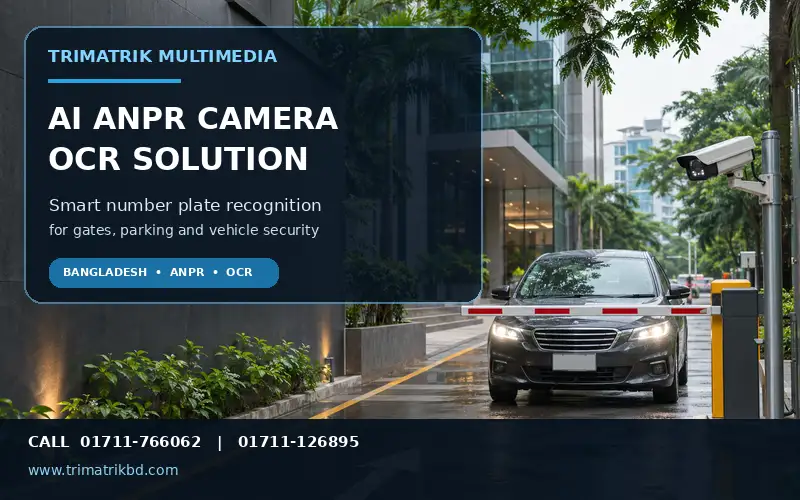
ANPR AI Camera OCR Solution in Bangladesh, Explore how ANPR AI camera OCR works in Bangladesh. TRIMATRIK MULTIMEDIA designs vehicle number plate recognition solutions for parking, gates, campuses, factories and transport facilities.
An Automatic Number Plate Recognition (ANPR) solution turns a vehicle’s plate image into usable information. A purpose-built AI camera captures the vehicle and plate, OCR software reads the characters, and a configured rule decides what happens next. The result may be a barrier opening for an authorized car, a visitor record for reception, an alert for security or a searchable entry and exit event. ANPR is also known as License Plate Recognition (LPR) or Automatic License Plate Recognition (ALPR).
The phrase ANPR AI camera OCR solution in Bangladesh covers more than a camera. It describes an integrated system that combines image capture, character recognition, access rules, barrier control, event storage and an operator process. TRIMATRIK MULTIMEDIA provides ANPR solution planning and implementation in Bangladesh for organizations that need more consistent vehicle access and reliable movement records.
Demand is visible in public transport infrastructure as well as private facilities. The Bangladesh Bridge Authority documents Electronic Toll Collection on the Jamuna Bridge and the Padma Bridge, and a 2026 Bangladesh e-GP package for the First Dhaka Elevated Expressway includes ANPR cameras with toll hardware, RFID, barriers and servers. These records show procurement and deployment activity; they do not establish a national market-size estimate or prove that ANPR alone powers every ETC lane.[1][2]
What Is AI Camera OCR in ANPR?
OCR means Optical Character Recognition. In ANPR, OCR identifies the letters and numbers on a vehicle registration plate and converts them into text that software can compare, store or use to trigger an action. AI-based recognition models help locate the plate in an image and interpret characters despite changes in angle, brightness, vehicle motion and background.
A standard overview of the process is:
Vehicle detection: A loop, radar, video trigger or camera analytics detects a vehicle approaching the capture zone.
Image capture: The ANPR camera uses its lens, shutter and illumination to capture a sharp image of the vehicle and plate.
Plate localization: The recognition engine identifies the plate area within the larger image.
OCR and validation: The software reads the characters, applies supported plate-format rules and may return a confidence score.
Decision and response: The recognized plate is compared with an allowlist, blocklist, visitor permission, schedule or payment condition. Depending on the rule, the system opens the barrier, logs the passage or asks an operator to review it.
Some systems process OCR inside the camera, while others send images or metadata to a server or software platform. This affects network use, latency, offline behavior, storage and integration. Before purchasing, confirm where recognition takes place, where plate records are stored and which component makes the final access decision.
Why the Camera and OCR Must Be Designed Together
OCR cannot recover information that the camera never captured clearly. The plate must occupy enough pixels in the image, remain in focus and avoid excessive glare, blur or obstruction. The camera angle, capture distance, lens, frame rate, exposure, shutter speed, supplemental lighting and vehicle speed all affect the image supplied to the OCR engine.
Manufacturer installation guidance provides useful engineering references but not universal guarantees. For example, a Hikvision installation guide specifies character pixel-height ranges for certain 2 MP and 4 MP camera configurations. Its vehicle-access guidance also describes example mounting ranges and a minimum plate-image resolution for a particular lens class. These values vary by camera and use case, so the installer should follow the chosen model’s documentation and verify image quality on site.[3][4]
In practical terms, an ANPR camera should be aimed so that the plate appears large, sharp and close to a front-facing view. Mounting too high or too far to the side increases perspective distortion. A wide field of view may show the whole lane but make the plate too small for reliable reading. A very fast vehicle may require a short exposure to limit motion blur, which in turn affects lighting requirements.
Bangladesh Plate and Site Conditions
Bangladesh Road Transport Authority (BRTA) publishes information on retro-reflective number plates and RFID tags, including their installation process. These reflectivity properties can support image capture, but real deployments still encounter dirty, bent, faded, blocked or non-standard plates. Plate styles, vehicle classes and character layouts should be verified against the actual traffic at the site rather than assumed from a generic regional setting.[5]
Weather and lighting are equally important. Rain can add reflections to the road and plate; direct sunlight may create backlight; headlights may wash out characters at night; and dust can reduce contrast. A project survey should examine the entrance at the times vehicles use it, including night operation, peak traffic and likely weather. If motorcycles, trucks, buses and private cars all use the same lane, test examples of every class.
Dhaka and other urban areas also have mixed traffic and limited gate space. At apartment buildings, offices, factories, hospitals, campuses, warehouses and commercial sites, a solution must account for queues, pedestrians, guard visibility and the physical location of the barrier. An ANPR camera should not be placed where it can only read a stopped vehicle if vehicles cannot safely stop there, or where a queue blocks a public road.
How an ANPR OCR Gate Works
At a controlled entrance, a vehicle approaches a marked capture point. A detector triggers the camera or the camera analytics detect the approach. The camera captures the plate and generates an OCR result, often with a timestamp, direction, lane and image evidence. The access software checks the plate against configured permissions. If the plate is authorized and any additional condition is met, the controller receives an open command. A safety loop, radar or other approved protective device prevents the barrier from closing onto a vehicle or person.
If the plate is unreadable, unregistered or below the configured confidence threshold, the safest response is usually to hold the barrier closed and ask the guard to verify the vehicle. Organizations can choose different rules, but exceptions should be logged. A manual open button or emergency release should be available to authorized staff, and the system should record who used it and when.
For entry and exit tracking, cameras or capture points must be configured for the relevant direction. Software can pair entry and exit events, calculate a parking duration or create a movement report if those features are part of the selected system. A camera alone does not manage parking fees, visitor approvals or payment settlement; those functions require software and, where applicable, payment integration.
Common Applications in Bangladesh
Residential buildings and gated communities: Register resident vehicles and create temporary visitor permissions. Guards can focus attention on unknown plates and maintain digital entry records.
Corporate offices and business parks: Apply employee, executive, contractor and visitor access rules by plate, schedule or gate. ANPR can complement access cards and visitor-management workflows.
Factories and industrial facilities: Record staff transport, supplier, contractor and delivery vehicle movements. Separate permissions can be defined for staff entrances, loading areas and restricted yards.
Hospitals and educational campuses: Manage staff, patient, student, parent, emergency and supplier vehicles. Priority and emergency access rules should be agreed with site administrators.
Hotels, shopping centres and paid parking: Capture entry and exit times and link them with parking software, ticketing or payment systems. The operator should define how to handle lost tickets, unreadable plates and vehicles that enter or exit through an unmonitored lane.
Warehouses and logistics yards: Improve traceability for delivery appointments, truck entry, gatehouse checks and loading activity. Integration with warehouse or dispatch software depends on supported interfaces and project scope.
Toll and road infrastructure: ANPR can support vehicle recognition, toll operations, traffic monitoring or exception review. Such deployments require lane-level engineering, resilient power and network systems, central operations, cybersecurity and integration with other identification or payment methods. Bangladesh’s public ETC and expressway procurement records illustrate the relevance of digital vehicle identification in transport projects.[1][2]
Selecting an ANPR AI Camera OCR System
Start with the requirement, not the megapixel count. Record how many lanes must be monitored, the direction of travel, vehicle speeds, capture distance, plate positions, day and night lighting, expected traffic volume and the event information staff need. Decide whether the system must recognize plates from moving vehicles or only at a controlled stop line.
Then verify these technical points with the provider:
Supported plate formats, vehicle classes and language or character requirements.
Minimum plate size in the image and the camera’s recommended mounting geometry.
Recognition processing location: on-camera, on-premises server or cloud service.
Confidence score availability, duplicate handling and low-confidence exception workflow.
Allowlist and blocklist capacity, visitor enrollment, scheduling and event search.
Barrier-controller interface, safety inputs, manual release and emergency behavior.
Image and metadata retention, storage sizing, user permissions and backup approach.
API, SDK, ONVIF or other integration method for CCTV, access control, parking or business software.
Warranty, firmware support, commissioning, operator training and maintenance coverage.
Product brochures may quote high recognition percentages under specific laboratory or installation conditions. They should not be treated as guaranteed performance for every Bangladeshi site. Agree on a site acceptance test that uses actual vehicles and operating conditions. Measure successful reads, incorrect reads, missed reads and manual interventions across daytime, night, rain, glare and representative vehicle classes. Define what will count as a pass before installation is signed off.
Privacy, Security and Operations
Plate records may be linked to employees, residents, visitors or customers. The organization operating the system should define why it collects these records, who may access them, how long they will be kept and how they will be deleted. Provide appropriate notice to people entering the site, limit access by role, log administrative activity and avoid using plate histories beyond the stated purpose. Public-road monitoring or broad surveillance may require additional legal and regulatory review.
Secure the camera and software using unique credentials, restricted administrative access, network segmentation, supported firmware, backups and a documented incident process. Do not expose cameras or servers directly to the public internet without a secure design. Determine whether a local system continues to operate when internet connectivity fails, what is stored locally and how records synchronize after recovery.
TRIMATRIK MULTIMEDIA ANPR Solution Provider in Bangladesh
TRIMATRIK MULTIMEDIA supports ANPR project planning and implementation in Bangladesh. Depending on site needs, a solution may include AI ANPR cameras, OCR configuration, barrier gates, safety sensors, access software, network and power design, integration, commissioning and user training. The right configuration depends on lane geometry, traffic, plate conditions and access policy.
For a useful consultation, prepare a site photograph or layout, number of lanes, entry and exit arrangement, approximate vehicle volume, vehicle types, desired barrier behavior and any existing CCTV or access-control equipment. This information helps the solution provider identify camera positions, integration needs and the appropriate acceptance test.
Conclusion
An ANPR AI camera OCR solution transforms a plate image into an access decision or searchable movement record. Its performance depends on the complete chain: camera placement, image quality, OCR configuration, database rules, barrier safety, network design and operator workflow. In Bangladesh, BRTA’s number-plate and RFID processes and public transport procurement activity provide relevant context, while private facilities can use ANPR to improve gate operations and vehicle accountability.[1][2][5]
The most reliable approach is to survey the site, confirm the supported plate formats, test actual vehicles and agree measurable acceptance criteria. TRIMATRIK MULTIMEDIA can help organizations plan an ANPR AI camera OCR solution for parking, security and vehicle access.
Contact TRIMATRIK MULTIMEDIA
Phone: 01711-766062, 01711-126895
Website: www.trimatrikbd.com (https://www.trimatrikbd.com/)
Frequently Asked Questions About ANPR AI Camera OCR
1. What is an ANPR AI camera?
It is a camera designed to capture vehicle registration plates and use recognition software to convert the plate image into readable characters and vehicle events.
2. What does OCR mean in ANPR?
OCR means Optical Character Recognition. It is the stage that reads the letters and numbers from the plate image and returns them as text.
3. Is ANPR the same as LPR or ALPR?
They are commonly used names for similar license-plate recognition technology. ANPR means Automatic Number Plate Recognition, LPR means License Plate Recognition, and ALPR means Automatic License Plate Recognition.
4. How does AI improve number plate recognition?
AI models can locate plates and interpret characters across varied image conditions. The result still depends on plate visibility, camera setup, supported formats and software configuration.
5. Can ANPR OCR read Bangladeshi number plates?
Support depends on the selected camera and recognition engine. Confirm the supported plate formats and test a representative sample of Bangladeshi vehicles at the intended site.
6. Does an ANPR camera open a barrier automatically?
It can, when the OCR result matches an authorized rule and the camera or software is integrated with a compatible barrier controller. Safety devices must control safe barrier movement.
7. Can ANPR work without an internet connection?
Some cameras and on-premises systems can recognize plates and control a gate locally. Cloud-dependent features may need internet. Confirm the exact offline behavior before deployment.
8. What is the difference between on-camera OCR and server OCR?
On-camera OCR processes the image at the camera. Server OCR sends the image or stream to a local or cloud server. Processing location affects bandwidth, resilience, latency and data storage.
9. Does a higher megapixel camera always read plates better?
No. The plate must receive enough pixels and remain sharp. Lens selection, angle, exposure, lighting, distance and vehicle speed matter alongside resolution.
10. How should an ANPR camera be positioned?
Follow the specific model’s installation guide and aim for a clear, near-front-facing plate image at the correct capture distance and height. Validate pixel size and OCR results on site.
11. Can ANPR read vehicles at night?
Yes, if the camera and illumination are suitable and exposure settings are configured correctly. Test headlights, low light and reflective plates during night commissioning.
12. Will ANPR work in rain?
It can, but rain, road reflections, water on the lens and reduced contrast may lower recognition quality. Use weather-appropriate equipment and include wet-weather tests.
13. Can an ANPR camera read moving vehicles?
Yes, when the camera’s shutter, frame rate, lens, lighting and recognition engine match the vehicle speed and lane geometry. Test at the real operating speed.
14. Can one camera monitor multiple lanes?
Some models support multiple lanes, but coverage depends on the lens, angle, distance and plate size. A site survey should confirm whether one camera can meet the recognition target for each lane.
15. Can ANPR recognize motorcycles and trucks?
Some systems support multiple vehicle types, but plate position and size vary. Include motorcycles, trucks, buses and cars in compatibility checks when they use the same entrance.
16. Can the system manage visitors?
Yes, if the software supports visitor enrollment or integration with a visitor-management platform. Define who can approve a vehicle and when that permission expires.
17. Can ANPR record entry and exit times?
Yes. With the required cameras or lanes and configured software, the system can log plate reads and timestamps and may pair entry and exit events.
18. Does ANPR calculate parking fees?
Only when connected to parking software configured with tariffs, entry/exit pairing and a payment workflow. The camera itself does not collect the fee.
19. What happens when a plate is unreadable?
The system can flag the event for guard review. Establish a manual verification and override workflow, and retain an audit record of the decision.
20. How should ANPR accuracy be tested?
Use representative vehicles and test by day, night, rain and glare. Record correct reads, incorrect reads, missed reads and manual interventions, and compare them with an agreed acceptance target.
21. Can ANPR integrate with CCTV or access control?
Often, when the selected devices and platforms support compatible APIs, SDKs, ONVIF metadata or relay connections. Specify the exact integration and data flow before installation.
22. Is ANPR being used in Bangladesh infrastructure projects?
Bangladesh e-GP has published a First Dhaka Elevated Expressway toll-system package that lists ANPR cameras among the equipment. Bangladesh Bridge Authority also documents ETC operations, which can involve other technologies such as RFID.[1][2]
23. How should vehicle plate data be protected?
Restrict access, use secure accounts and networks, maintain access logs, set a retention period and delete records when they are no longer needed. Give appropriate notice and review applicable requirements.
24. Who provides ANPR AI camera OCR solutions in Bangladesh?
TRIMATRIK MULTIMEDIA provides ANPR project planning and implementation in Bangladesh. Contact the team with your site layout, lane count, vehicle volume and integration needs.
الكاتب
eHajira
التعليقات
لا توجد تعليقات بعد.